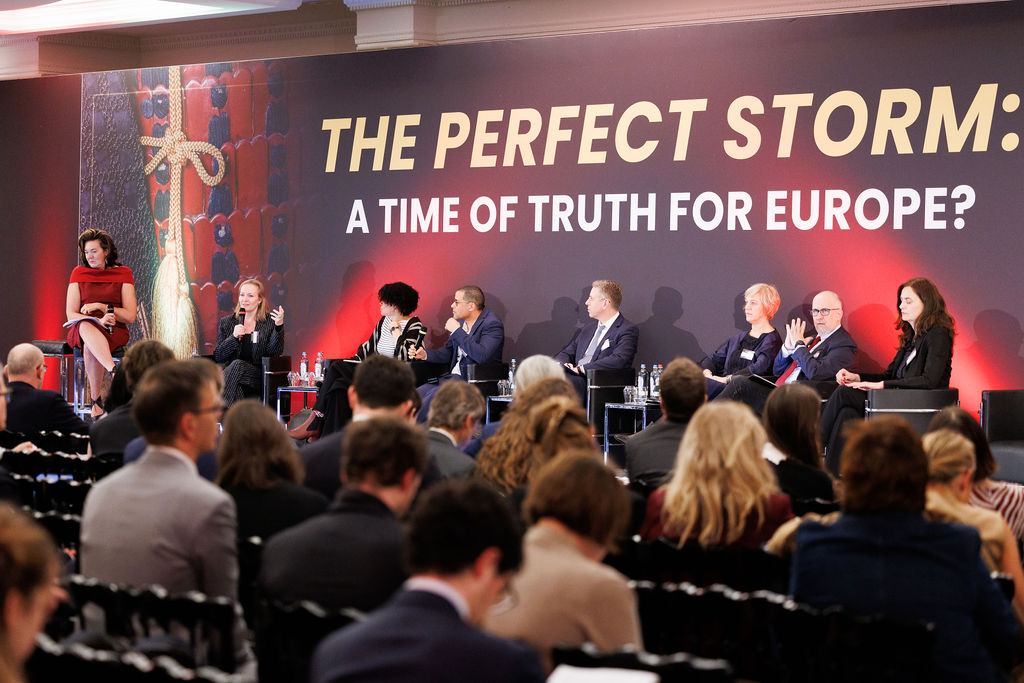
Today’s post reports on the afternoon panel of the conference “The Perfect Storm: A time of truth for Europe?” that took place in Brussels, on 30 January 2025. The panel, titled “Algorithmic amplification, platform power, freedom of speech, and tech oligarchs” was composed by:
- Frank McCourt, Project Liberty
- Renate Nikolay, DG Connect, European Commission
- Guy Rolnik, University of Chicago
- Marietje Schaake, Stanford Cyber Policy Center
- Alexandra Geese, Member of European Parliament
- Chi Onwurah, Member of UK Parliament
- Jacob Mchangama, The Future of Free Speech
- Dovev Lavie, Bocconi University
- (Moderator) Cristina Caffarra, Centre for Economic Policy Research
Free speech and content moderation
The discussion started with the observation that free speech is being weaponized by social media platforms to undermine democracy. The debate comes in the wake of Mark Zuckerberg’s announcement that Meta is changing its policies for content moderation by getting rid of fact-checkers and replacing them with community notes, similar to X. According to Jacob Mchangama, the practice of restricting online content has grown stricter than idealized in the human rights declaration, and that a lot of comments that are deleted in this mechanism are perfectly legal. In his view, the crowdsource model is one with the potential to work, and we need solutions that empower users with choice about the information they are exposed to.
Alessandra Geese brought up the example of Germany’s strict system of media pluralism against power concentration in media and very clear legislation on freedom of speech and also speech that is prohibited, such as holocaust denial. “And you know who imposed that on Germany as a pre-condition to become a free country again? It was the Americans, who saved us from the Nazi regime after World War II.” Geese believes that the freedom of speech argument is being weaponized by tech billionaires and by the political side benefiting from the concentration of power and the algorithmic amplification of their speech.
That’s an American invention: media pluralism, limitation of market power in media. Because they had understood very well what the mass communication did to the German population and how it created consensus for the Nazi regime. — Alessandra Geese
Users lack control over their data
Frank McCourt brought to the attention that policy-making is “no match” for the speed and economic power of today’s technological development. A large problem is that users don’t have control over their data on the Internet, which has become a centralized, surveillance-based, and autocratic technological operation that is incompatible with democracy. This lack of user control has made platforms highly manipulative as they aggregate and profile users to feed them targeted information that triggers subconscious behaviors. “I don’t know what else we need to see to wake up to the fact that the [current] design of internet technology is incompatible with democratic ideals and principles and basic human rights”. The main challenge that alternative models bringing control back to the user face today is reaching scale.
The tech debate is about power
Marietje Schaake argued that the tech debate is all about power and the legitimacy of who gets to decide over and govern our lives. Broadly, according to her, we have the question of legitimacy raised by the fact that companies today are curating the information landscape based on shareholder interests. This condition triggers a systematic problem of transparency because we don’t have the ability to independently verify what these companies are doing. Guy Rolmik pointed to how these algorithms are reshaping society by influencing what we see, what we hear, and how we think. “If we do not confront the role of algorithms in shaping our public discourse, the last 50 or 60 years of liberal democracy may become a distant memory.”
These are old issues in new clothes. These are issues about power, about human rights, about the citizen, about the role of the State. — Chi Onwurah
Schaake also addressed concerns about the loss of the US as a defender of democracy. “The whole giving up on being part of a coalition of democratic countries that care about protecting democracy, now only caring about deals, weaponizing the rules-based order, not respecting rules, going after minorities, going after previous partners. It is a deeply depressing moment that Europe is at this alone. Europe is the only game in town that can change the reality of an outsized power in the business community that has now merged with the political, anti-democratic power of the Trump administration.” In this respect, Renate Nikolay mentioned how Europe is working on the Democracy Shield programme to tackle systemic risks. According to her, Europe is recognizing, election after election, that the threat of organized and manipulative disinformation systems is evolving beyond platforms.
Below is the recording of the full panel discussion. Please note that this audio was recorded from my seat using my mobile phone so you may hear some interference in the sound. The recording starts 5-10 minutes into the conversation.
Discover more from Aldeota Global
Subscribe to get the latest posts sent to your email.
 Aldeota Global